
Lesson 2.1
Anatomy of the impulse & wave personality
5-3-5-3-5, the hard rules and the sentiment signature of each wave
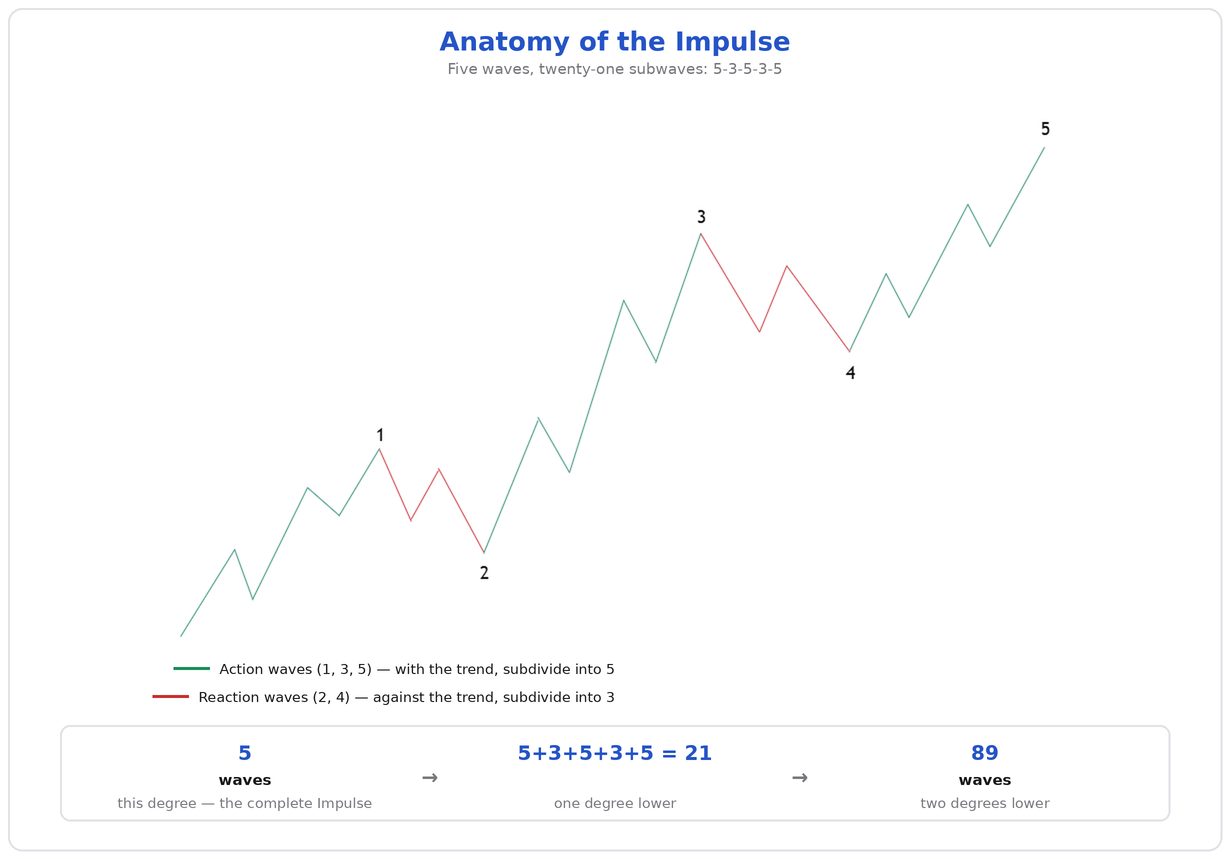
In short: An Impulse consists of 21 smaller waves in a 5-3-5-3-5 pattern. Each of the
five waves has a recurring sentiment signature — you can often recognize it while
it's in progress. Always check both: the structure and the personality.
The Internal Structure
Motive waves come in two forms: as an Impulse (the far more common case — the topic of this lesson) and as a Diagonal (Lesson 2.3). The Impulse is structured internally as follows:
- Waves 1, 3, 5 are action waves — they move in the direction of the trend and subdivide into fives.
- Waves 2, 4 are reaction waves — they move against it and subdivide into threes.
In short: 5-3-5-3-5. A complete Impulse thus consists of 5 + 3 + 5 + 3 + 5 = 21 waves of the next lower degree. One degree lower, it's 89. These numbers are no coincidence — you know 2 → 8 → 34 from Module 1.5, and in Lesson 2.5, this will become a tool.
The Key Question That Will Guide You Through the Entire
Learning Path
If you consider a move on the H4 to be wave 3, it must resolve into five subwaves on the M15. If it doesn't, but instead shows a clear three, your labeling is very likely wrong — the move is then more likely a wave B, a wave X, or part of a correction.
The Rules in Their Precise Formulation
1. Wave 2 retraces less than 100% of wave 1. 2. Wave 4 retraces less than 100% of wave 3. 3. Wave 3 always moves beyond the end of wave 1. 4. Wave 3 is never the shortest of the three action waves 1, 3, and 5. 5. Specifically for the Impulse: Wave 4 does not enter the price territory of wave 1.
A clarification on point 4: The rule is satisfied as soon as wave 3 makes a larger percentage move than wave 1 or wave 5. On the timeframes you trade in FX, the difference to pip measurement is negligible. Regarding point 5, the restriction for FX and CFD traders: The overlap rule applies without restriction to unleveraged cash markets. In highly leveraged markets, short-term price extremes can occur that would not exist in the cash market — however, it is documented that such overlaps are limited to daily and intraday fluctuations and are rare even there. This is not a free pass, but a measured tolerance:
| Observation | Assessment |
|---|---|
| Overlap of a few pips on the M15 chart | does not disqualify an otherwise clean count |
| Overlap that retraces half of wave 1 | very much disqualifies it |
The Wave Personality — What Separates Wave Analysis from
Pattern Recognition
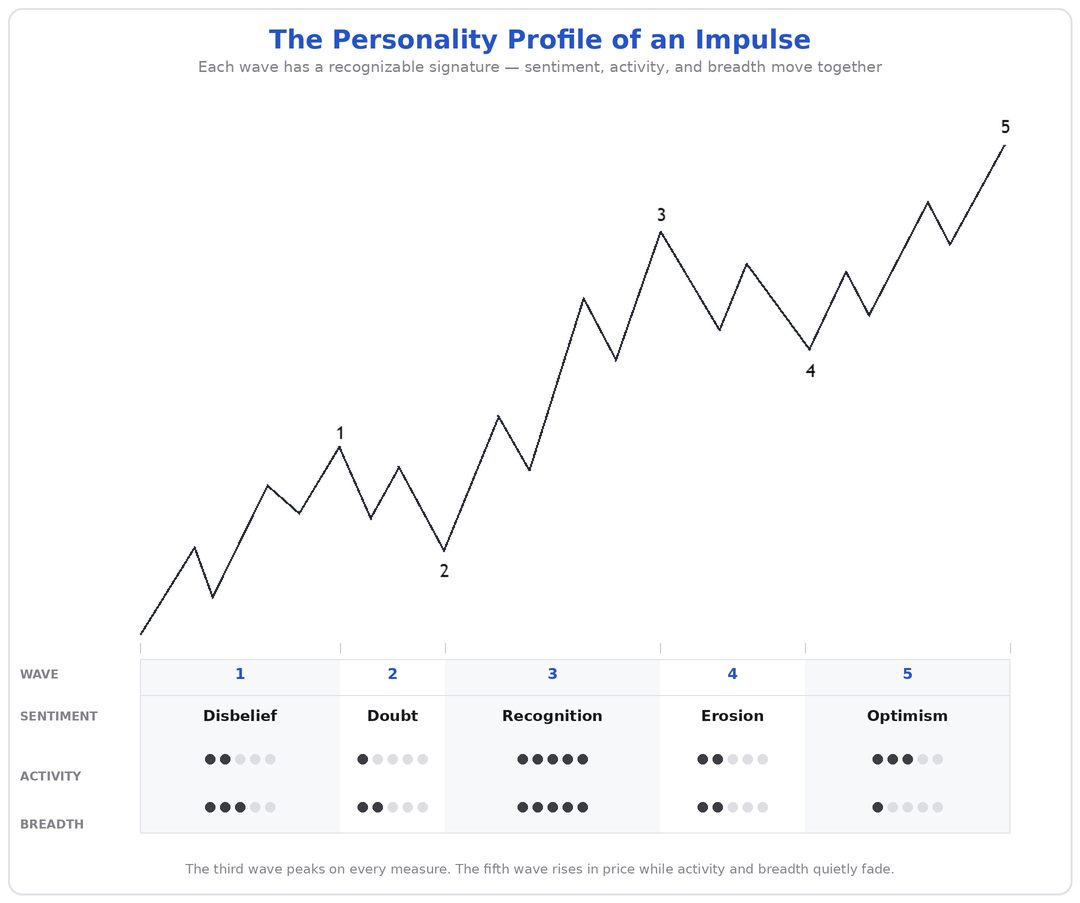
Each wave in the cycle has a recurring sentiment signature: a characteristic interplay of market breadth, activity, news flow, and dominant emotion. Those who know these signatures can often identify a wave while it is still in progress — instead of labeling it retrospectively. And precisely where multiple counts are permissible according to all rules, the personality is the deciding factor.
Wave 1 — Disbelief, in Two Forms
About half of all first waves are part of a basing process and are therefore strongly retraced by wave 2. Market participants are still fully attuned to the old trend; there is plenty of positioning against the move. Technically, however, this rally is more constructive than all counter-trend moves in the preceding downtrend. The other half arises from large bases, failed downward moves, or extreme compression — from such starting points, first waves are dynamic and are only moderately corrected.
| Origin of Wave 1 | Expectation for Wave 2 |
|---|---|
| from a basing process | deep retracement — 61.8% and more |
| from compression / failed move | shallow retracement — 38.2% to 50% |
An addition that is worth its weight in gold in daily FX trading: First waves don't have to prove anything in terms of momentum. Only third and fifth waves have to meet momentum standards. Therefore, downgrade the significance of momentum indicators until a suspected third wave of a third wave becomes visible. Exception: If wave 1 starts with a clear divergence between the indicator and the price, the trend has very likely reversed.
Wave 2 — Doubt
Second waves often retrace so much of wave 1 that the accumulated profit almost completely disappears. Market participants are thoroughly convinced that the old trend is back. The key technical characteristic: Second waves often end on very low activity and volatility — the selling pressure visibly dries up without the price falling below the starting point of wave 1.
Wave 3 — Recognition
Third waves are strong and broad; the trend is unmistakable. Increasingly favorable fundamental data comes into the picture as confidence returns. Third waves typically generate the most activity and the largest price movement and are most often the extended wave of a series.
Two refinements for the foreign exchange market. First: The third wave is almost always steeper than the first, often nearly vertical — and it should not hug a trend line drawn from the origin of wave 1 to the end of wave 2. Second: Its thrust is regularly confused with a five-wave ending thrust. The only useful distinguishing feature is activity:
| Observation | Likely Classification |
|---|---|
| vertical movement with exceptionally high activity | third wave, possibly extended |
| vertical movement with lower activity than the preceding | five-wave ending thrust |
impulse
Wave 4 — Erosion Beneath the Surface
Fourth waves are the most predictable waves of the cycle in terms of depth and form because they must differ from the preceding second wave of the same degree according to the guideline of alternation. They usually move sideways and build the base for the final fifth wave. Beneath the surface, the weaker pairs of the same block are already forming their extremes — this nascent decay prepares the signs of weakness for the fifth wave.
For the forex market, there is a deliberate deviation from the textbook version of alternation: In FX, the principle applies more strongly to the magnitude than to the pattern.
| Wave 2 has retraced | Expectation for Wave 4 |
|---|---|
| 61.8% or more | 38.2% or less |
| only 38.2% | more likely 23.6% or 50% |
Wave 5 — Optimism Without Substance
Fifth waves are always less dynamic than third waves in terms of market breadth and usually also show a lower maximum speed of price change. Exception: If the fifth wave is an extension, the speed in its internal third wave can exceed that of the superordinate third wave. The typical technical feature is momentum divergence: The price makes a new extreme, the oscillator does not. Sentiment reaches its extreme while market breadth narrows — this contradiction is the fifth wave.
The Corrective Waves in a Brief Profile
- Wave A is almost always interpreted as a mere pullback in the old trend. Its structure already reveals the upcoming corrective form: if A unfolds in five waves, a Zigzag is likely; if A unfolds in three waves, it points to a Flat or Triangle (Modules 3 and 4).
- Wave B is the most deceptive move of the cycle: rarely technically strong, narrowly supported, and almost always destined to be fully retraced by Wave C. Rule of thumb: If you say to yourself, "something is not right with this market," it is very likely a B-wave.
- Wave C acts like a third wave: five-waved, broad, without significant resistance.
The Time Factor — With a Consequence
How to Work with It: The Double-Check
1. The Structure: Five or Three on the degree below? 2. The Personality: Do the activity, breadth, and sentiment match the wave I am labeling here?
A count that is structurally permissible but does not fit psychologically — for example, a "Wave 3" without expanding activity and without follow-through momentum — is almost always the inferior of two counts. This double-check is the core of what experienced analysts call the "right look" of a wave.
Wave personality was the point for me where Elliott stopped being a mystery. Before, I was looking for shapes. Today, I first ask: Does the market feel like a Third — or like a Fifth that is rallying one last time?
Knowledge check
1. How many waves of the next lower degree does a complete Impulse consist of?
2. Which statement about subwave 3 of an Impulse is correct?
3. You consider a move to be wave 3, but find a clear three on the degree below. What follows?
4. A market makes a nearly vertical move. How do you distinguish between a third wave and a five-wave ending thrust?
5. Wave 2 has retraced 61.8% of wave 1. What retracement do you expect for wave 4?
6. True or false: "Wave 3 must always be the longest action wave."