Lesson 2.4
The truncated fifth wave
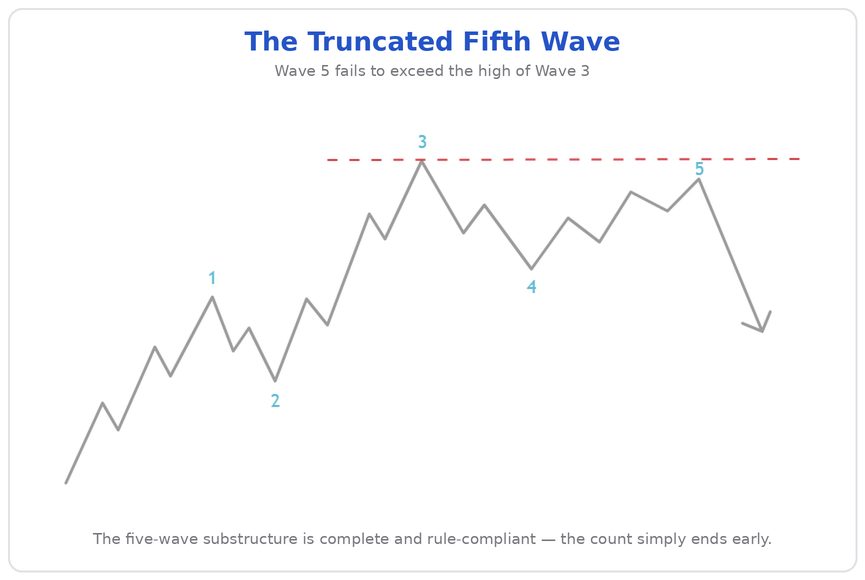
Not every fifth wave reaches a new extreme
In short: Not every fifth wave reaches a new extreme. If it falls short of the extreme
of the third wave, it's called a Truncation — which is only allowed if its five-wave
substructure is complete and rule-compliant. It is common on the hourly chart.
The Definition
If the fifth wave does not exceed the end of the third, it's called a Truncation (truncated fifth wave; Elliott originally called it a "Failure"). In an upward impulse, the high of wave 5 remains below the high of wave 3; in a downward impulse, the low of wave 5 remains above the low of wave 3.
The Decisive Condition — and the Line Between It and an
Excuse
This point is the entire difference between a legitimate special form and a convenient excuse for a count that doesn't work out.
When It Occurs
Truncations typically follow an exceptionally strong third wave — documented cases of a larger degree consistently confirm this. This leads to a position-sizing consequence, which you'll find in Lesson 2.5: If wave 3 was exceptionally strong and covered ground very quickly, wave 5 has an increased chance of ending in a Truncation.
How Often — and Where
| Time Frame | Frequency |
|---|---|
| Weekly and daily chart | quite rare |
| Hourly chart | quite common |
For an intraday and swing trader in FX, the Truncation is therefore not an exotic special case, but a regularly recurring event. That's precisely why it gets its own lesson.
What It Signals
What Happens Next — Two Precise Regularities
1. The correction aims for the maximum. The subsequent correction will likely target the
2. The missing distance is made up. If a five-wave sequence falls short of its ideal Fibonacci
The Trap Afterwards: The Missed High is Recaptured
If the fifth wave falls short of the Fibonacci targets, the B-wave of an irregular correction within the following fourth wave of the higher degree often recaptures this extreme — it then reaches precisely the level where the fifth wave should ideally have ended. Anyone who blindly stays on the opposite side after a Truncation will be stopped out, even though their analysis was correct. The consequence is not a different count — but different stop management.
Practical Handling
1. Don't treat price targets in the fifth wave dogmatically. If the market completes a full
2. Completeness before extreme value. Your exit decision depends on "Is the structure
3. Keep it as an alternative scenario, not the main count. As long as the fifth wave is in
4. Take divergences more seriously. If wave 5 shows a clear momentum divergence from the
5. Adjust position size in advance. If the third wave was exceptionally strong, you go into the
Distinction
| Potential for Confusion | Difference |
|---|---|
| Ending Diagonal that still reaches its extreme | three-wave substructure (2.3) — both can occur |
| Wave B that doesn't reach the previous extreme | there is no impulse present at all |
| a fifth wave that is not yet complete | the structure is simply not finished yet |
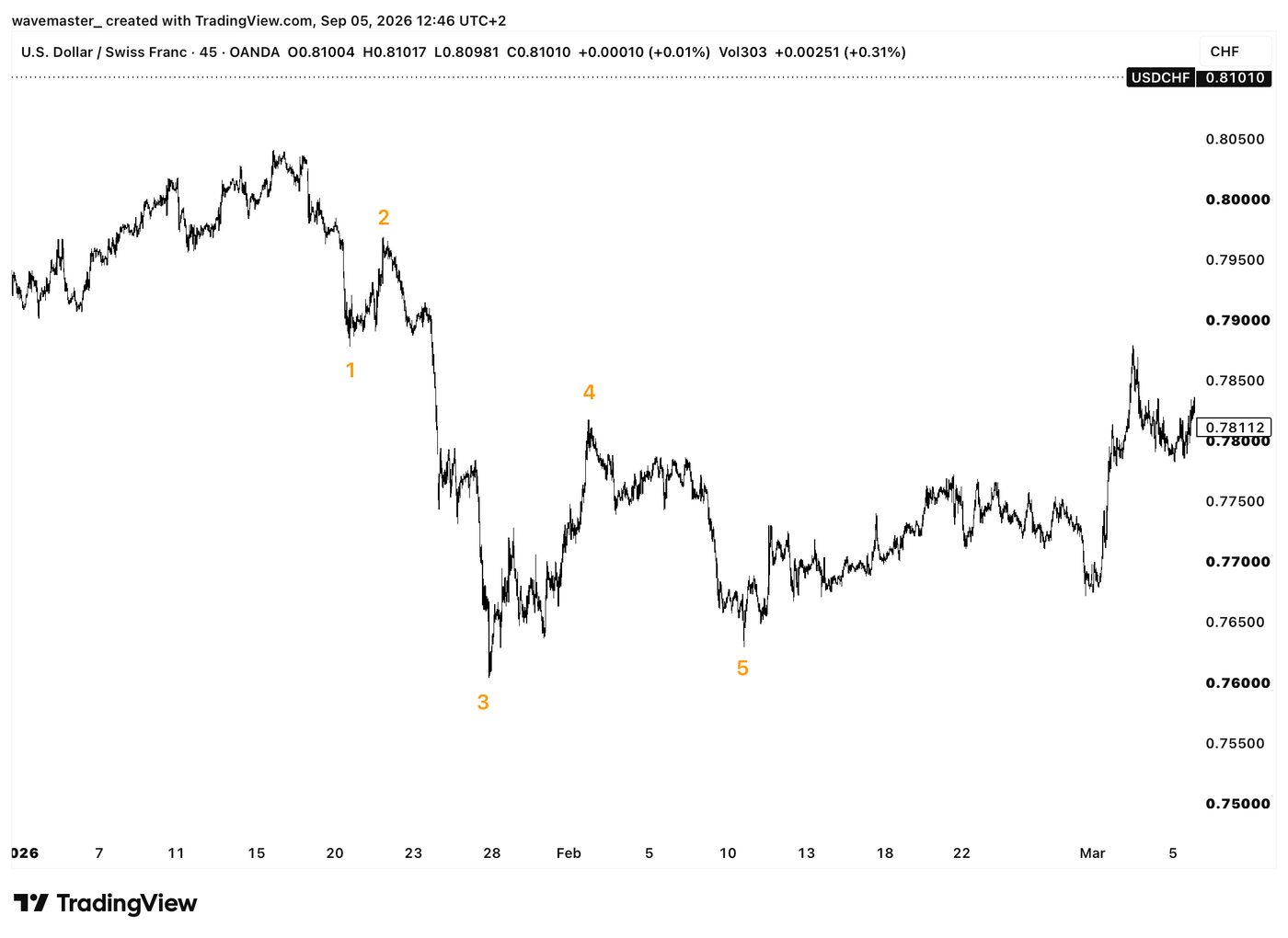
Truncation has taught me to treat targets as expectations and structures as facts. If the five-wave structure is complete and the momentum is fading, I take my profit — even if I'm three pips short of my drawn target.
Knowledge check
1. What does a Truncation describe?
2. In which time frame is a Truncation particularly common?
3. What condition must be met for a Truncation to exist?
4. Wave 5 falls 40 pips short of its Fibonacci target. What does this imply for the correction?
5. True or false: 'A Truncation can be reliably predicted in advance.'
6. After a Truncation, the market moves as expected, but then rises to the exact level missed by wave 5. Explanation?