
Lesson 2.2
Extensions
Which wave extends – and how to spot it early
In short: In almost every real impulse, one of the three motive waves is significantly
longer than the others — this is an extension. Once you know which wave has
extended, you can estimate the size of the remaining waves. A structural
observation becomes a price target.
Why real charts don't look like textbook pictures
The idealized impulse has five waves of comparable size. Real charts look different: One of the three motive waves is usually significantly longer than the other two and more clearly subdivided in its substructure. This phenomenon is called an Extension — an impulse wave with exaggerated subdivisions that is completely out of scale.
Where extensions occur — with figures for the forex market
| Extended Wave | Share in FX |
|---|---|
| Wave 3 | approx. 60% |
| Wave 5 | approx. 35% |
| Wave 1 | approx. 5% |
The crucial difference from the stock market lies in the fifth wave: At around one-third, it is by no means an exception in the forex market. A market that accelerates again in the fifth wave is not a reason to discard the count — but a very good reason to prepare for profit-taking. And a guideline for the bigger picture: If the fifth wave of a sequence extends, this entire sequence is itself wave 3 of a larger formation in about 80% of cases.
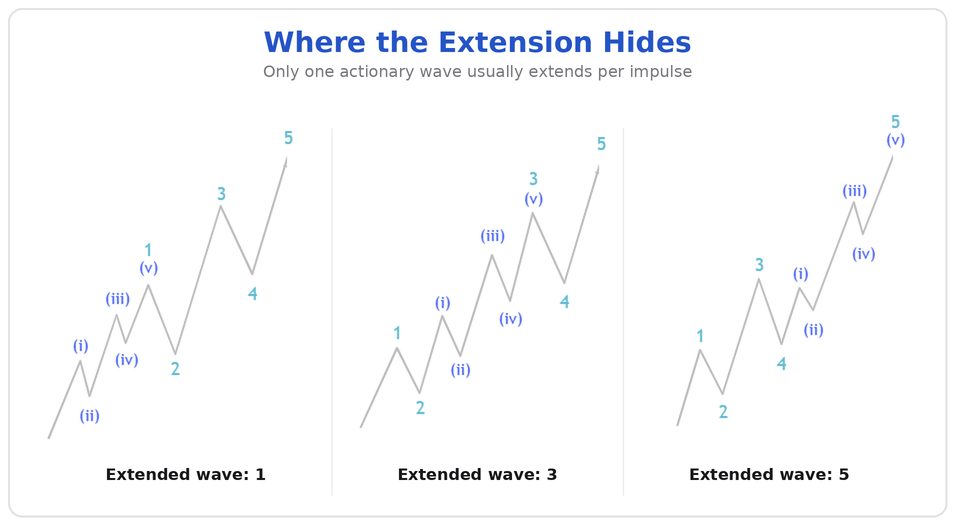
How to recognize an ongoing extension early
1. Wave 3 surpasses the 161.8% target of wave 1 without any relevant consolidation.
2. The pullbacks remain unusually shallow. Corrections within an extension are typically
3. The substructure remains impulsive, the momentum confirms: New price extremes are
4. The move does not hug the trendline. A third wave that crawls along the line connecting the
The midpoint control: The middle of the third wave within the extended third wave usually marks the midpoint of the entire third wave movement. Anyone who identifies the center of the 'third of the third' has a rough but useful idea of how much further the move can go.
Extension within an extension: The third wave of an extended third is typically an extension itself. Waves within an extension can be larger in scale than the preceding waves of the higher degree — if size relationships confuse you, this is often the reason. In such a phase, the exact labeling of the inner degrees is secondary. What matters is that you are on the right side of the market and know your invalidation level.
The most important real-time technique of the entire module
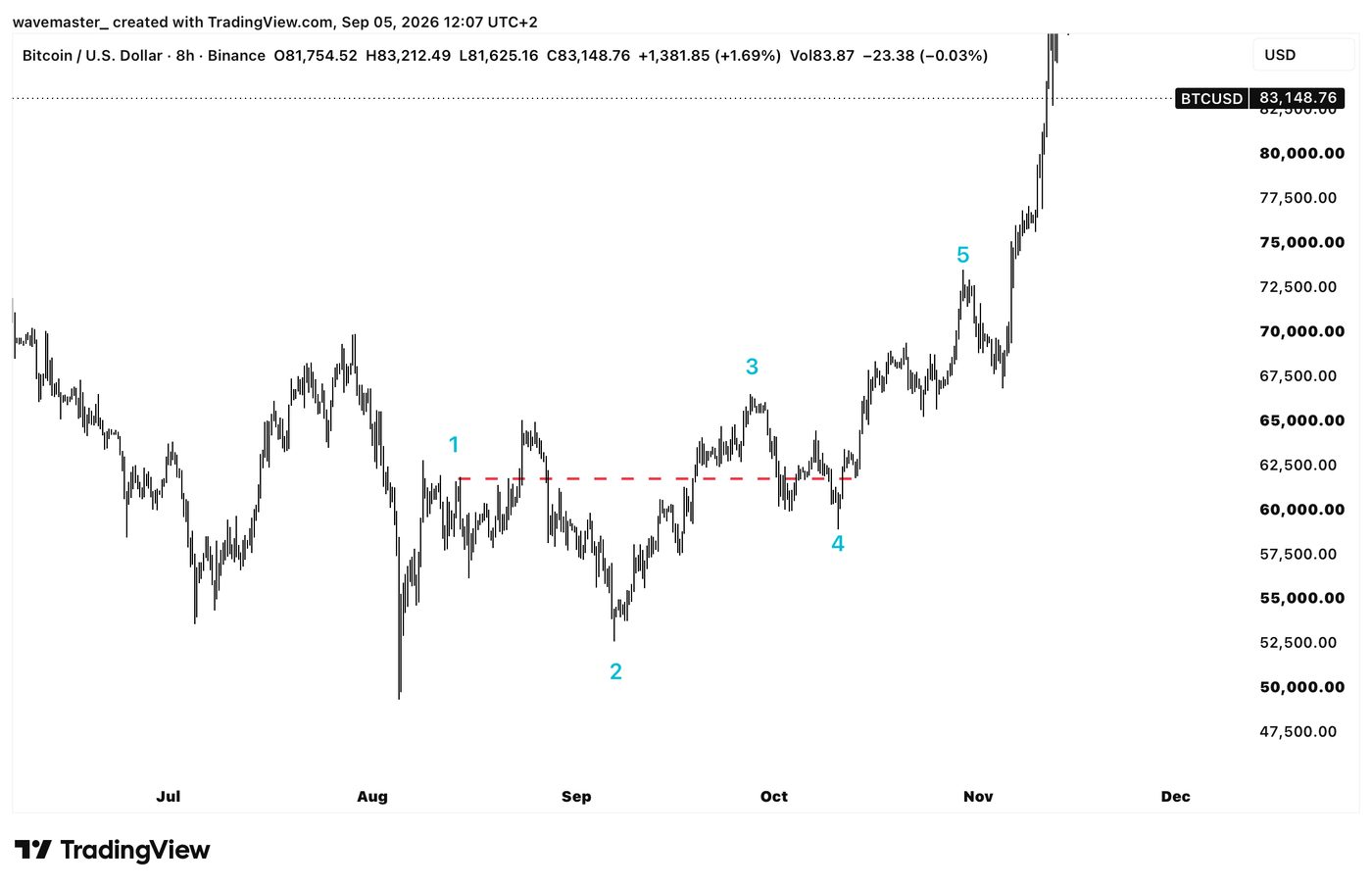
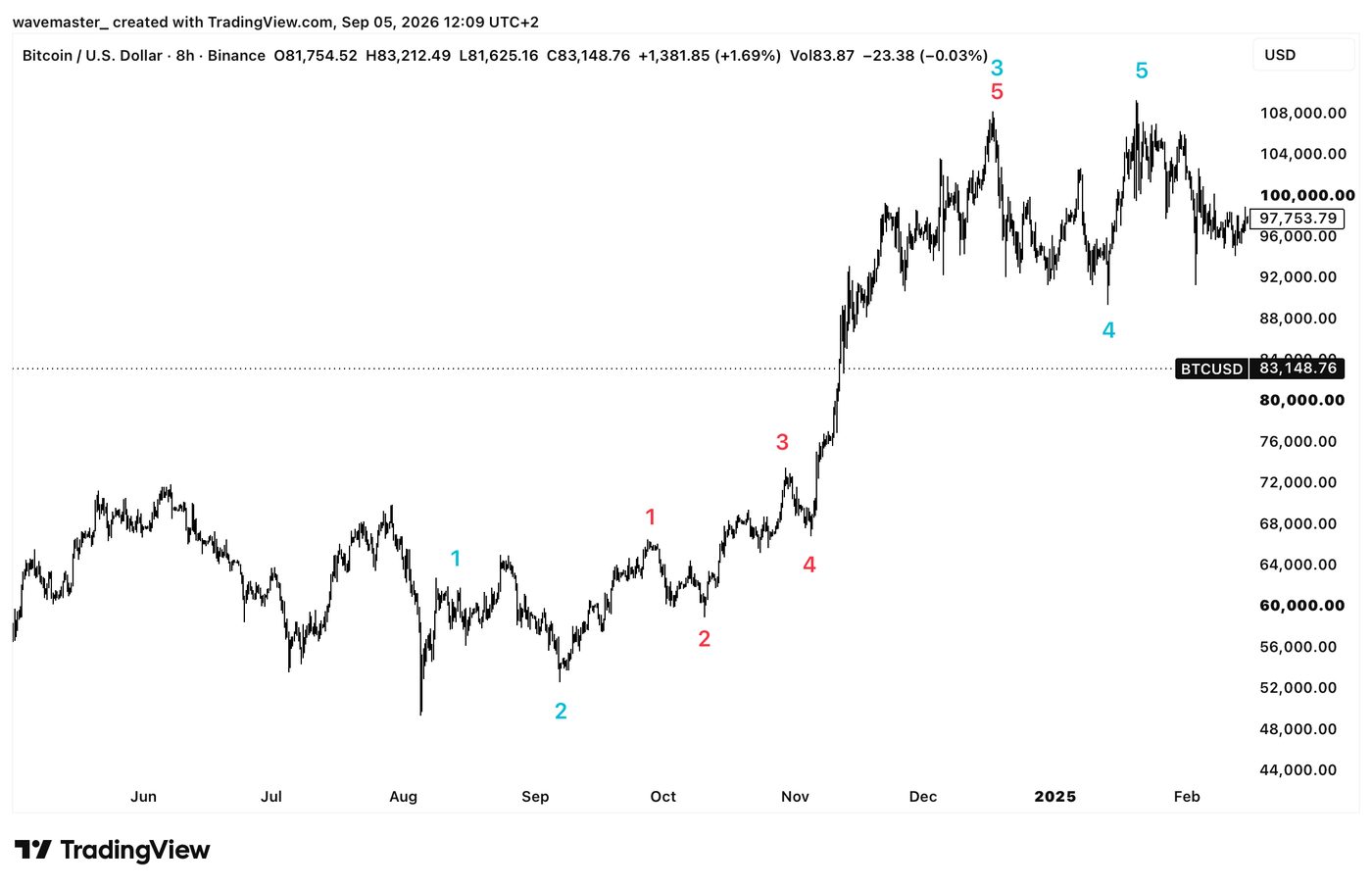
The situation: You are counting an ongoing move as 1-2-3-4-5, but the labeling violates a rule — either wave 4 overlaps wave 1, or wave 3 is shorter than wave 1 and wave 5. Both are invalid.
The same situation from another perspective: A series of overlapping waves in a place where neither a horizontal triangle nor a diagonal is expected usually turns out to be an extension. The reason so many fail at this: A sequence of first and second waves of a smaller degree visually mimics an ending formation. The resumption of the trend then hits the unprepared trader suddenly — with full force, because that's exactly where the third of the third begins.
The behavior after an extended wave
After an extended fifth wave, a sharp correction follows, and it finds support at the level of the low of wave 2 within the extension (in an uptrend). Sometimes the entire correction ends there, sometimes only the A-wave. The key point: This low is usually in the price area of the preceding fourth wave of the next higher degree — two independent guidelines confirm each other. This is your first encounter with confluence.
After an extended first wave, the correction following the fifth wave typically targets the low of the second wave of the lower degree — not the area of the fourth wave. This is especially true if the fifth wave is significantly smaller than the third.
- After identifying an extension, you have a concrete, structurally-based target for a counter-trend
- Taking profits in an extended fifth wave is not fearfulness, but craftsmanship — extended fifth
The nine-wave case
If the sub-waves of an extended wave have nearly the same amplitude and duration as the other four waves, the visual result is not a five, but a sequence of nine waves of roughly equal size. It then sometimes becomes impossible to determine which wave is the extended one — and that is irrelevant: A nine-wave count and a five-wave count have the same technical significance.
And a thought that completes the picture: The extension itself is an expression of the principle of alternation — the motive waves alternate in their length. Typically, the first is short, the third is extended, and the fifth is short again.
The 1-2-(1)-(2) relabeling has saved more third waves for me than any other tool. When my count violates a rule, I no longer ask 'where is the mistake?', but rather 'which extension is just beginning here?'.
Knowledge check
1. In how many motive waves of an impulse does an extension typically occur?
2. Which double extension is permissible?
3. Which wave extends most frequently in the forex market — and how often?
4. How deep are pullbacks within an extension typically?
5. You are counting 1-2-3-4-5, but you notice that wave 4 is entering the territory of wave 1. What is the most likely relabeling?
6. True or false: 'In a sequence of nine roughly equal waves, the extended wave must be clearly identified, otherwise the count is worthless.'