Lesson 3.2
The zigzag
5-3-5, the wave-B limit as invalidation and 1.618 × A in FX
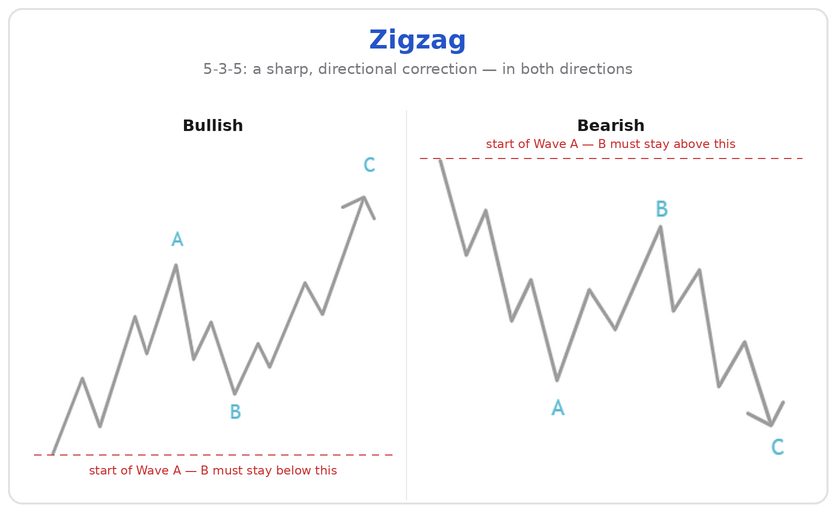
In short: The Zigzag is the sharp correction — A-B-C with the substructure **5-3-5**. Its
hard limit: Wave B never extends beyond the start of wave A. Your stop will later be
placed at this line.
What it's about
The Zigzag is what most traders intuitively call a "pullback": fast, steep, deep. And it's the pattern you'll base most of your wave 2 entries on — the standard setup from lesson 2.5 depends on it.
The Structure
| Wave | Substructure | Meaning |
|---|---|---|
| A | five-part | motive — the correction starts with |
| B | three-part | corrective — the recovery attempt |
| C | five-part | motive — the second downward |
The crucial visual characteristic: The high of B is clearly below the starting point of A. The Zigzag does not reach the old extreme again — that's why it appears sharp and one-sided. In a bear market, the same pattern runs inversely upwards (reversibility from Module 1.5); it is then occasionally referred to as an inverted zigzag.
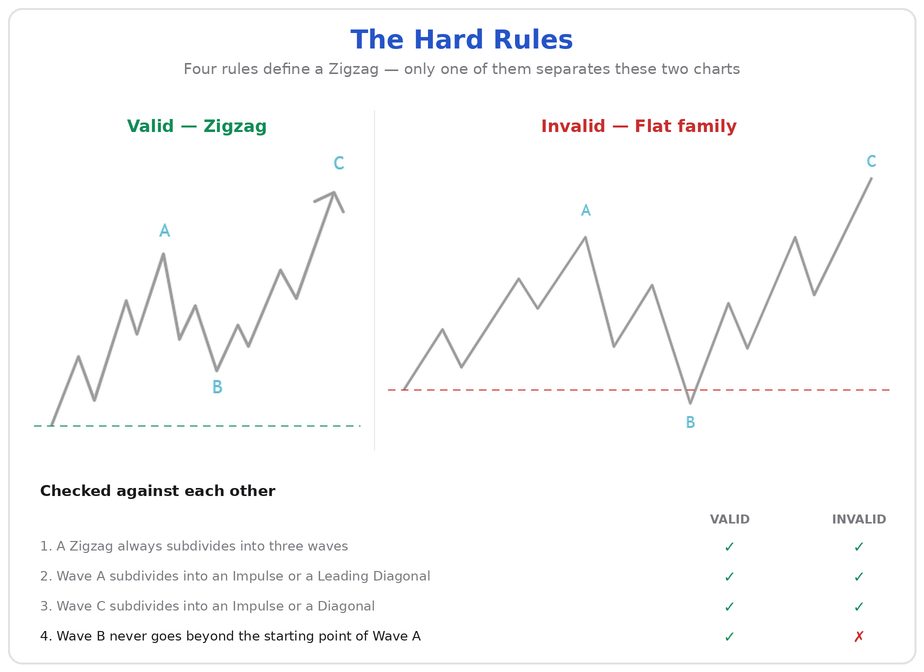
The Hard Rules
1. A Zigzag always subdivides into three waves. 2. Wave A always subdivides into an Impulse or a Leading Diagonal. 3. Wave C always subdivides into an Impulse or a Diagonal. 4. Wave B never goes beyond the starting point of wave A. It can be a Zigzag, a Flat, a Triangle, or
The Guidelines
- Wave A almost always subdivides into an Impulse (not a Leading Diagonal).
- Wave C almost always subdivides into an Impulse.
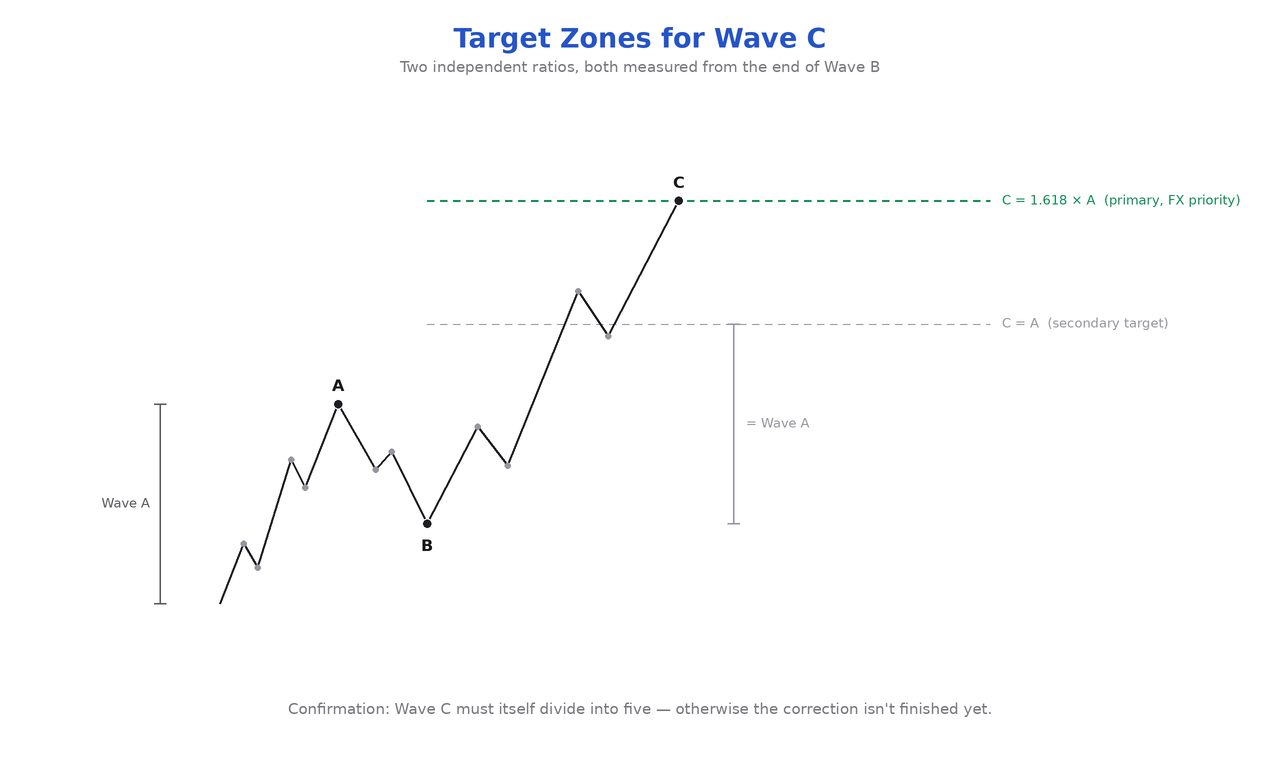
- Wave C is often approximately as long as wave A.
- Wave C almost always ends beyond the end of wave A.
- Wave B typically retraces 38–79% of A. If B is a Zigzag: usually 50–79%; if B is a Triangle: 38–50%.
- A line through the ends of A and C often runs parallel to a line from the end of B to the start of A — a target for C can be derived from this.
The Proportions — and an important divergence of sources
| Market | Common Relation | Second most common |
|---|---|---|
| Stock market | C = A | 1.618 × A or 0.618 × A |
| Forex market (FX) | C = 1.618 × A | C = A |
How deep does a Zigzag go?
Zigzags belong to the deep corrections. They typically retrace 61.8% or more of the immediately preceding impulse wave — especially in the position of the second wave. If the deep correction happens to be in the fourth wave, the retracement is usually 50%, rarely 38.2%.
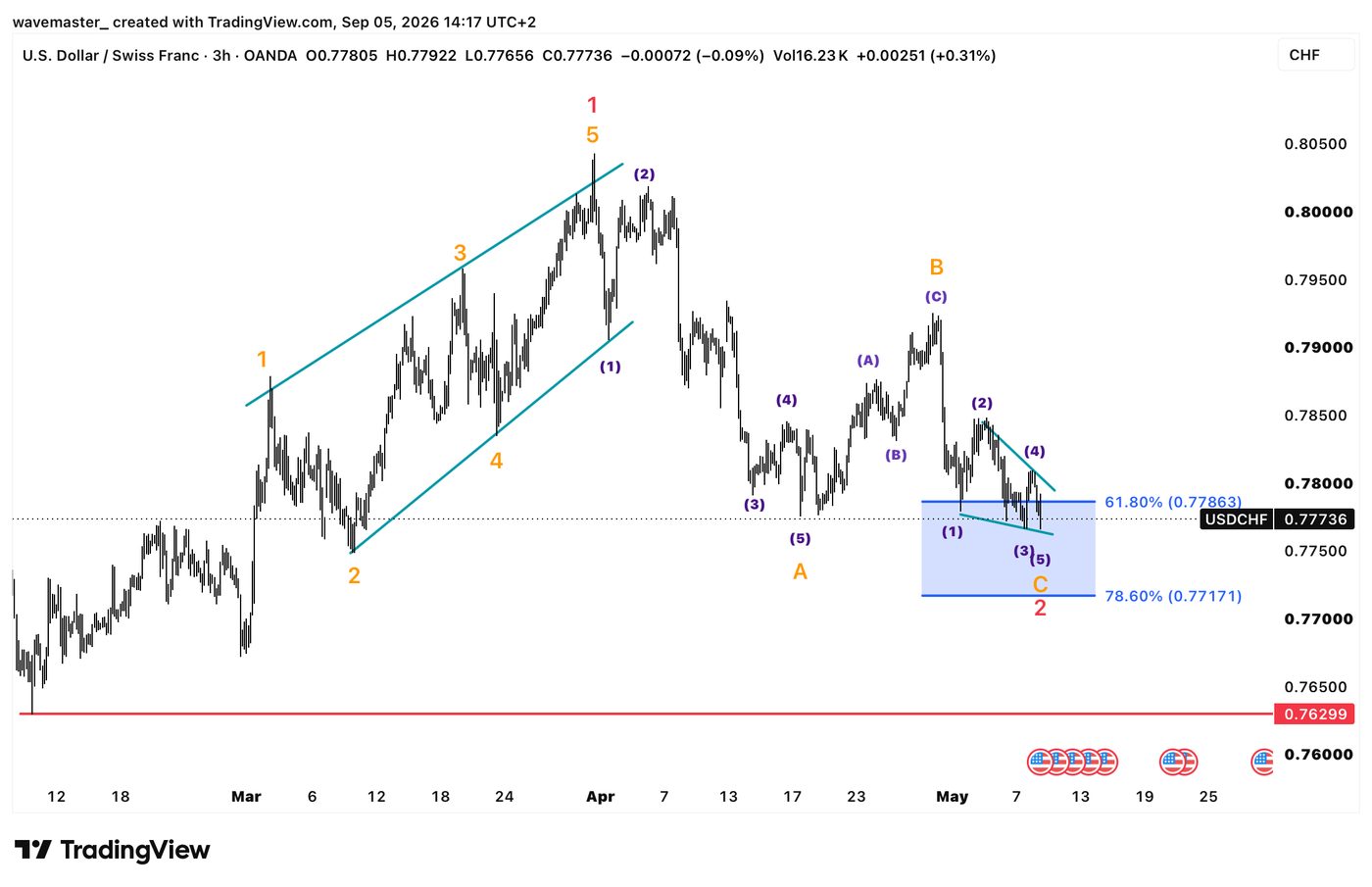
Where Zigzags appear
A pattern you should know, but don't need yet
Occasionally, Zigzags occur twice, or at most three times, in a row — especially when the first Zigzag has missed a normal price target. In between, there is always a corrective intervening wave: Double Zigzag or Triple Zigzag. The notation with W, X, and Y belongs in Module 4 — for now, it's enough that you know the term.
From Pattern to Setup
1. Invalidation: Start of wave A. If this level is surpassed, the Zigzag thesis is dead. 2. Target zone for C: 1.618 × A (FX priority), C = A as the second target. 3. Confirmation: C must be divisible into five waves. If you only count three there, you probably
Knowledge check
1. Substructure of the Zigzag?
2. Wave B of a Zigzag may ...
3. Wave A is 100 pips long. Which C-target do you prioritize first in FX?
4. Wave C can only be subdivided into three waves. What does that imply?