
Lesson 1.2
The base pattern: the 5-3 cycle
Motive & corrective – the binding vocabulary
In short: The market makes progress in five waves and corrects it in three. Five-wave
moves go with the trend, three-wave moves go against it — this one distinction is
the most important tool of the entire method.
Two phases, eight waves
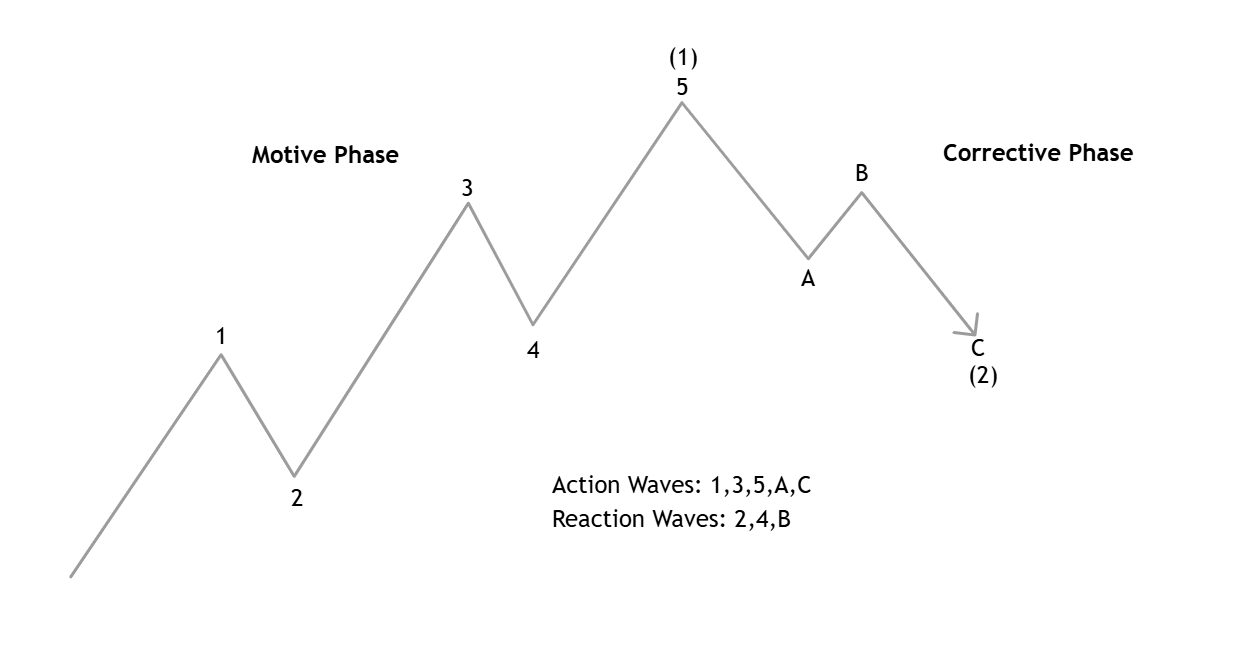
Markets don't move toward their destination in straight lines. They alternate between progress and retracement — and both phases have a fixed structure. A complete cycle consists of eight waves in two phases.
Remember the association: Numbers for Motive waves, letters for Corrective waves. This applies to every chart in this learning path. (In older literature, you might also encounter 'cardinal waves' or 'impulse waves' for the number phases, and simply 'three-wave moves' for the letter phases — they mean the same thing.)
Why specifically five and three?
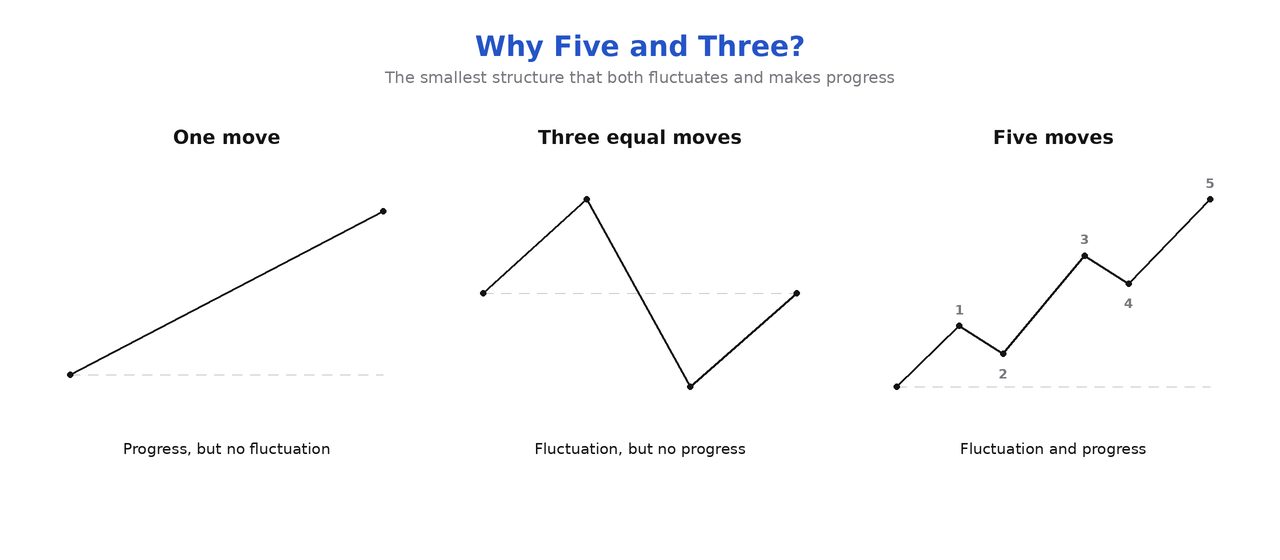
Elliott himself never answered this question — he just observed that it is so. The reason was provided later, and it's surprisingly simple: Five-and-three is the minimum required for a movement to both fluctuate and make progress.
- One wave does not allow for fluctuation.
- Three waves of equal size create fluctuation — but no net progress: up, down, up ends where the single upward wave would have ended, just with a detour.
- Only five waves can achieve both: The movement fluctuates and still gains ground, because there are three thrusts against two setbacks.
More waves would be possible — but inefficient. The structure is therefore not arbitrary, but necessary: It is the most economical form of progress under uncertainty.
The most important rule of thumb of the entire method
1. 'Motive' is a function, not a direction. In a downtrend, the five-wave Motive structure points
2. Action and reaction: Action waves move in the same direction as the wave one degree higher
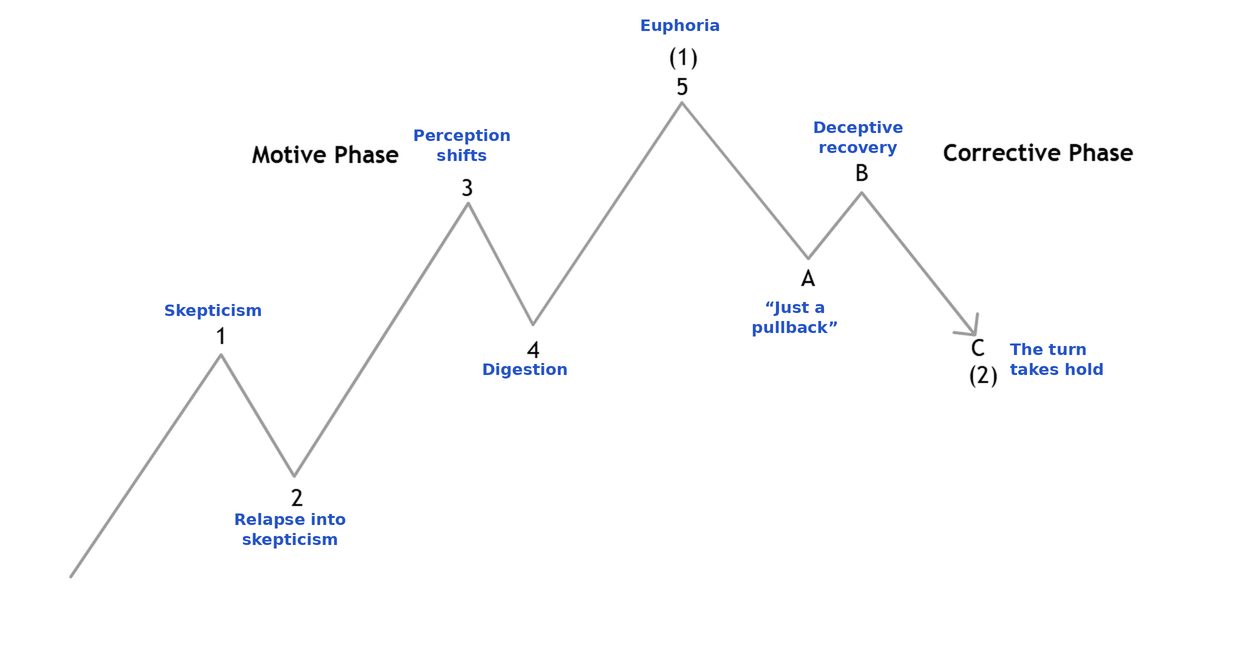
The psychology behind the eight waves
| Wave | Sentiment | What happens |
|---|---|---|
| 1 | Skepticism | The new trend begins from an |
| 2 | Relapse into skepticism | The market gives back a large part of |
| 3 | Perception shifts | The new trend is recognized. |
| 4 | Digestion | Early buyers take profits. The market |
| 5 | Euphoria | The final push, carried by the broad |
| A | 'Just a pullback' | The first break. The majority |
| B | Deceptive recovery | The market recovers — and lures in |
| C | The turn takes hold | Now the majority gets it. The part of |
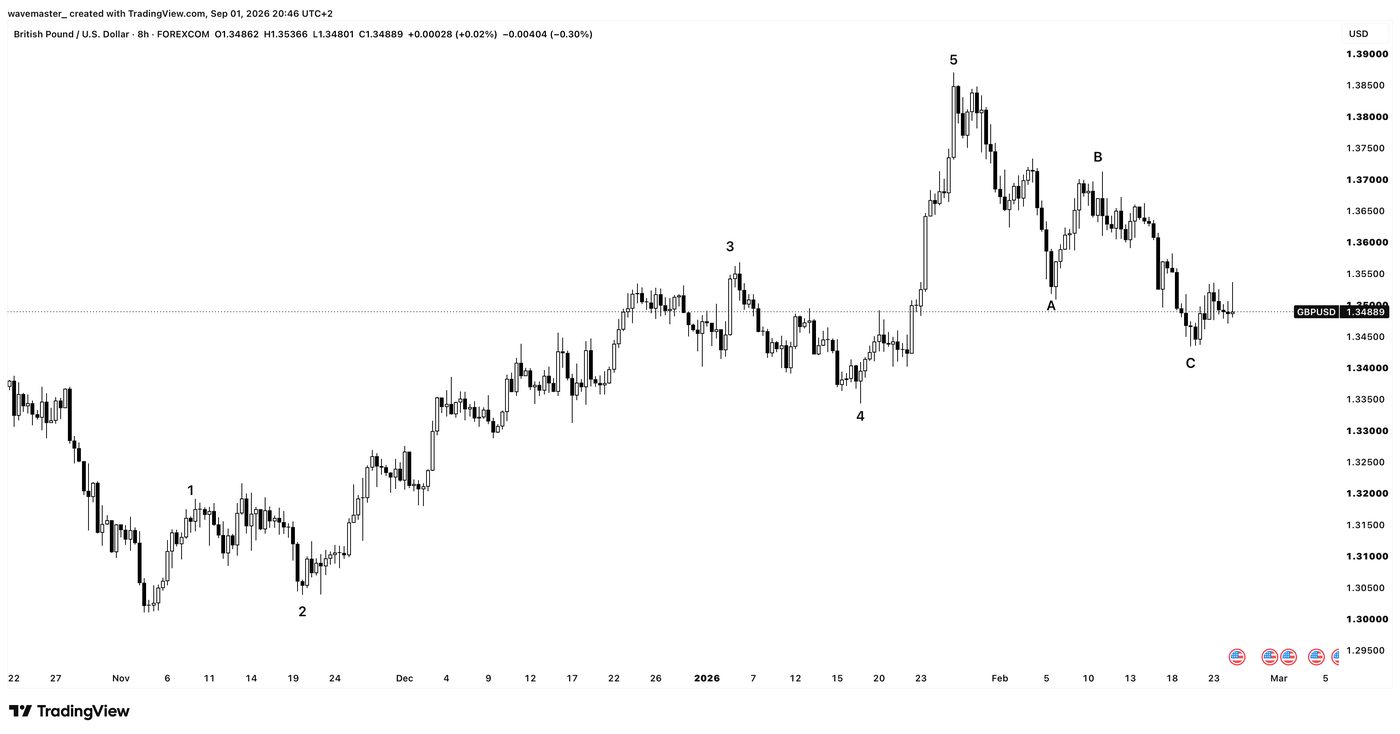
An expectation that will save you from frustration
The cycle as a building block
A completed 5-3 cycle — eight waves — itself forms only two waves at the next higher degree. The five-wave phase is wave 1, 3, or 5 of a larger cycle; the three-wave phase is its wave 2 or 4. The basic pattern is thus also the market's construction principle on all levels.
The question 'Five or Three?' is still the first one I ask of any chart — before any indicator, before any opinion. It takes thirty seconds and has saved me from more bad trades than anything else.
Knowledge check
1. How many waves does a complete Elliott cycle consist of?
2. Why are three waves in the direction of the trend not enough?
3. Which waves are action waves?
4. A counter-move clearly unfolds in five waves. What does this imply?
5. Approximately how much time does the FX market spend in consolidations?