
Lesson 1.3
The rules of the impulse
Three rules that make every count testable
In short: Three rules apply without exception — if one is broken, the count is wrong.
Period. It is this rigidity that turns an opinion into a testable hypothesis: Each rule
creates a price level at which your scenario is objectively invalidated.
Rules and Guidelines: the Architecture of the Method
- A Rule applies without exception to all waves to which it refers. It must never be broken.
- A Guideline describes what is typical, but not mandatory. Guidelines later help weigh between multiple rule-compliant interpretations — they will be covered starting in Module 5.
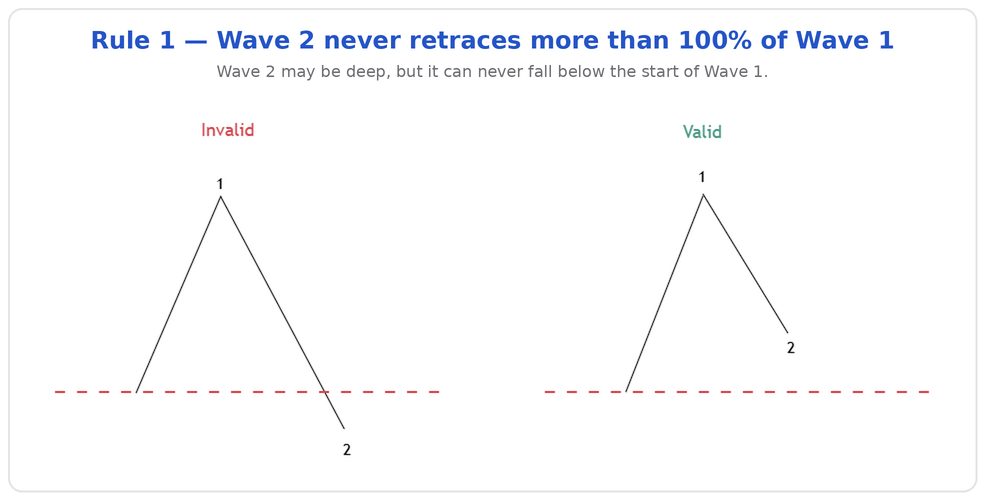
Rule 1: Wave 2 never retraces more than 100% of Wave 1
In an uptrend, Wave 2 can retrace arbitrarily deep — even 90 percent and more occurs. But it must not go below the starting point of Wave 1. The logic: Wave 1 marks the beginning of a new trend out of an extreme sentiment. If the market falls completely below this starting point, the 'new trend' hypothesis is not weakened, but invalidated. In a downtrend, the rule applies in reverse.
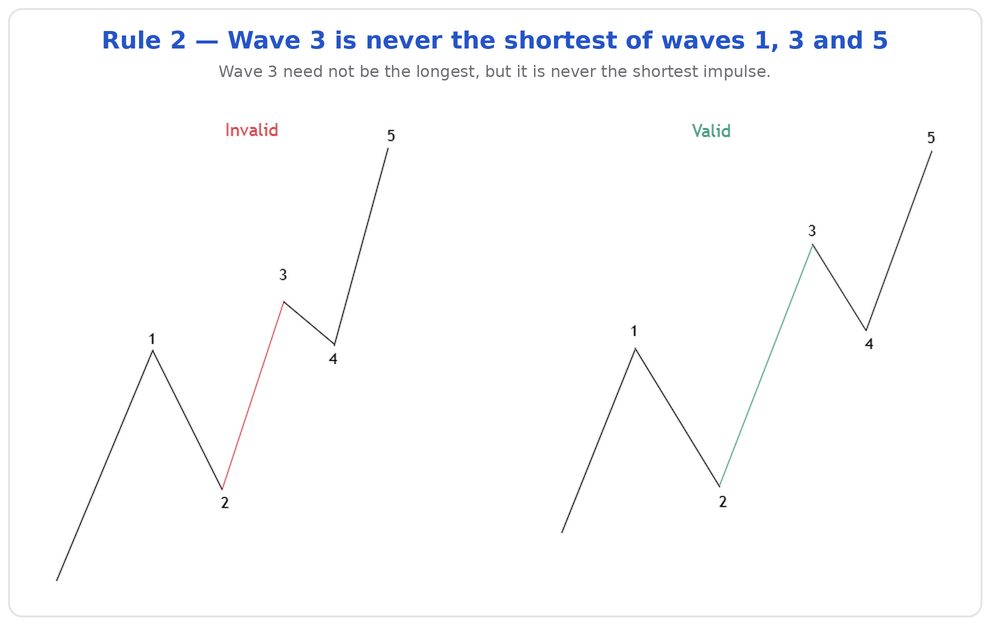
Rule 2: Wave 3 is never the shortest of the three actionary
waves
Among waves 1, 3, and 5, Wave 3 can never be the shortest. It doesn't have to be the longest — in practice, it usually is. If your current count shows a Wave 3 that is already shorter than Wave 1, then Wave 5 must remain shorter than this Wave 3 — otherwise the count is invalid. The check is made based on the percentage movement; in FX, the difference from measuring in pips is negligible.
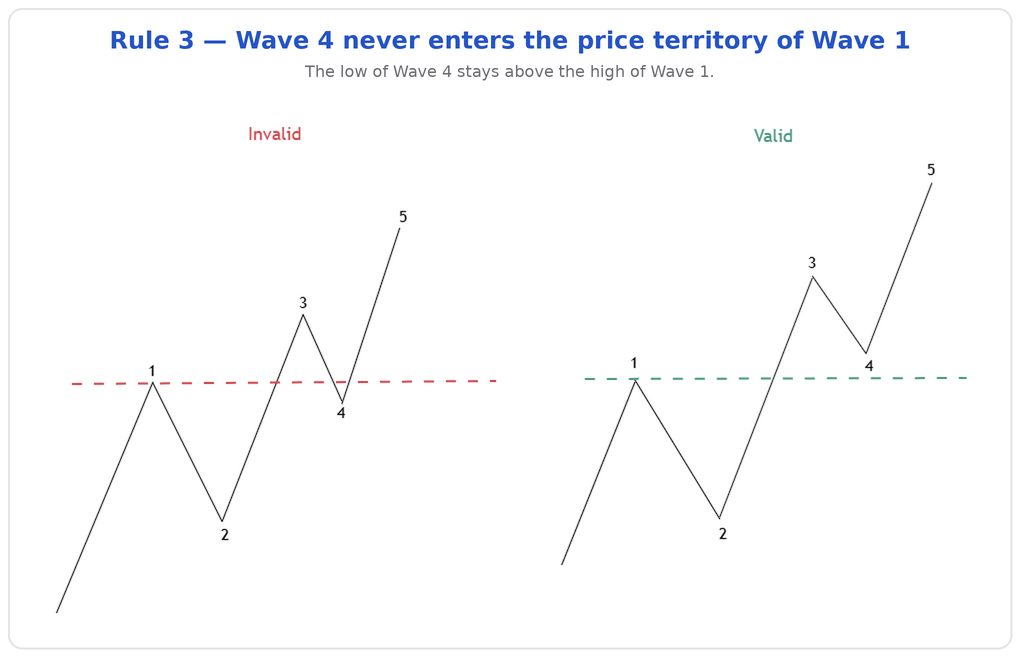
Rule 3: Wave 4 never enters the price territory of Wave 1
In an uptrend, the low of Wave 4 must not fall below the high of Wave 1; in a downtrend, it must not rise above the low of Wave 1. If the price ranges overlap — technical term: Overlap —, it is not a regular impulse. The logic: An intact impulse defends territory once conquered.
- There is exactly one known exception. Motive waves occur as an Impulse (the normal case)
- Leverage is not a free pass. Overlaps in leveraged markets are limited to daily and intraday
The Complete Rule Set
- Wave 4 never retraces more than 100% of Wave 3 (same logic as Rule 1, one degree further).
- Wave 3 always moves beyond the end of Wave 1. If it stays below it, it wasn't a Wave 3.
The purpose of all five conditions in one sentence: A Motive wave exists to make progress — and the rules ensure that it does.
Why These Rules Uphold the Method
1. Stop Placement: Each rule-based level is a natural candidate for the stop-loss from Module 0.4
2. Scenario Management: Competing counts can be sorted by their invalidation levels and
3. Discipline: A count that violates a rule isn't 'creative'. It is wrong. The unfitting price section is a
The three rules didn't change my trading because they tell me what the market will do — but because they tell me when I'm wrong. In advance. In writing. No discussion.
Knowledge check
1. What is the difference between rules and guidelines?
2. Wave 2 moves below the starting point of Wave 1. What is true?
3. Wave 3 is shorter than Wave 1. What must necessarily follow?
4. In which formation is an overlap of Wave 1 and Wave 4 rule-compliant?
5. True or False: 'Because FX is leveraged, I can interpret the overlap rule generously.'