Elliott Wave Essentials · 35 min · Intermediate
Triangles
Learn the different triangle patterns: Contracting, Barrier and Expanding.
What are Triangles?
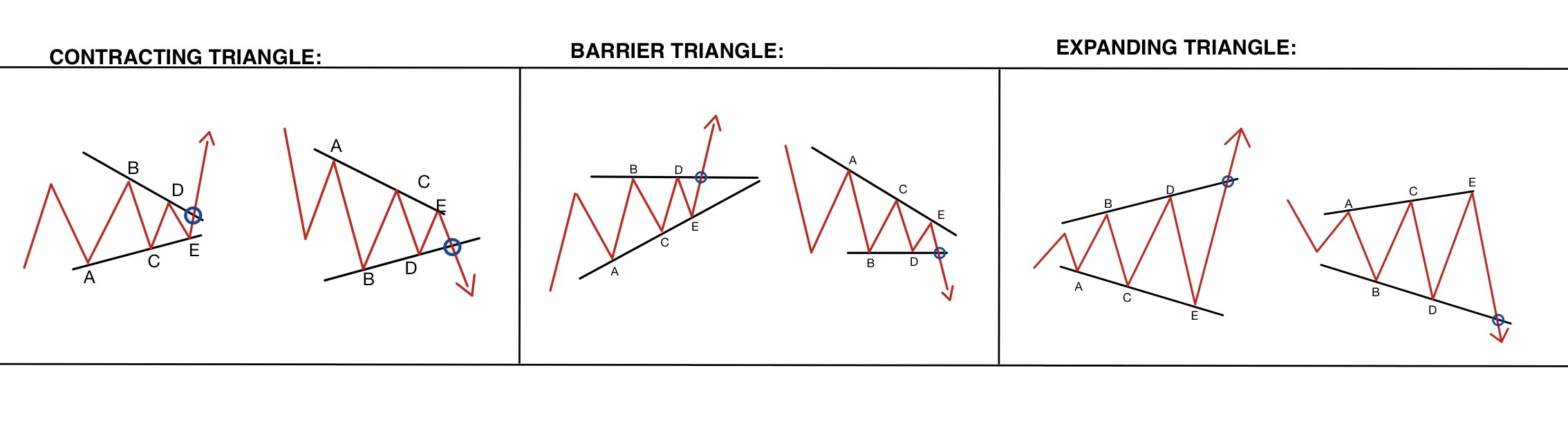
Triangles are 5-wave corrective patterns where price moves between two converging or diverging lines.
📐 Structure: A-B-C-D-E (all 5 waves have 3-part structure)
📍 Where: In wave 4, B, X (rarely in Y)
⚡ After: Thrust (breakout) in trend direction
1. CONTRACTING TRIANGLE (Symmetrical Triangle)
The most common triangle pattern. Both boundary lines converge towards each other.
Structure and Characteristics
- Both lines converge (move together)
- Each wave is shorter than the previous one
- The 5 waves form a symmetrical triangle
- All waves have 3-part internal structure (3-3-3-3-3)
The two variants
📈 Ascending:
- Lower line rises
- Upper line falls or horizontal
- Both converge upward
📉 Descending:
- Upper line falls
- Lower line rises or horizontal
- Both converge downward
Important Rules
❗ At least 4 touch points with trend lines
❗ Wave E often falls below the A-C line (throwover)
❗ Wave E can be shorter than D
❗ All 5 waves have 3-part structure
Trading Strategy
After Wave E:
- Expect a thrust (breakout) in trend direction
- Target: 61.8% - 100% of the widest part of the triangle
- Entry after confirmation of breakout above/below triangle boundary
2. BARRIER TRIANGLE (Triangle with Flat Side)
Also called running triangle. One side is horizontal like a barrier.
Structure and Characteristics
- One side horizontal (resistance or support)
- The other side converges to the horizontal line
- Waves B and D end at the same height (in ascending)
- Shows strong resistance/support
The two variants
📊 Ascending Barrier:
- Upper line horizontal (resistance)
- Lower line rises
- Wave B and D at same height
- Compression from below
📊 Descending Barrier:
- Lower line horizontal (support)
- Upper line falls
- Wave A, C, E at same height
- Compression from above
Important Rules
❗ One side MUST be horizontal
❗ Wave E does NOT cross the barrier
❗ At least 3-4 touches of the horizontal line
❗ Shows strong support/resistance
Special Feature
Barrier triangles show that the market repeatedly fails at a price zone. After the triangle, an explosive breakout often occurs as pressure has built up.
3. EXPANDING TRIANGLE (Megaphone)
The rarest triangle. The lines diverge instead of converging!
Structure and Characteristics
- Both lines diverge (move apart)
- Each wave becomes larger than the previous one
- Shows increasing volatility
- Often with high uncertainty/panic
Why is it rare?
Expanding triangles occur when:
😰 Extreme uncertainty exists in the market
📢 Rising volatility and wild fluctuations
💥 Emotional overreactions by market participants
⚠️ Often at the end of large moves
Important Rules
❗ Wave C exceeds Wave A
❗ Wave D exceeds Wave B
❗ Wave E exceeds Wave C
❗ Rising amplitude in all waves
Trading Strategy
⚠️ CAUTION: Expanding triangles are dangerous to trade!
- Wait for completion of wave E
- Expect a sharp reversal after
- Often at the end of large trends → trend change possible
- Trade only with tight stop-loss
Where do triangles occur?
📍 In wave 4 (most common - before final wave 5)
📍 In wave B (within an ABC correction)
📍 In wave X (between corrections in complex patterns)
⚠️ Rarely in wave Y (but possible)
❌ NEVER in wave 2
Comparison of the Three Triangle Types
| Property | Contracting | Barrier | Expanding |
|---|---|---|---|
| Frequency | ⭐⭐⭐ | ⭐⭐ | ⭐ |
| Lines | Converge | One horizontal | Diverge |
| Volatility | Stable | Consistent | Increasing |
Reversibility of structures
Every wave structure shown here can also appear inverted in a different market phase. An impulsive move in an uptrend, for example, appears mirrored in a downtrend.
What matters is always the direction of the higher-degree trend — the patterns stay the same, only their orientation changes.
Keep reading for free
Log in or create a free WaveMaster account to unlock this lesson — and every module, Trading Basics and the Elliott Wave Essentials.