
Lesson 0.4
Order types
Market, limit, stop – plus stop-loss, take-profit, lots and leverage
Two Prices, One Spread
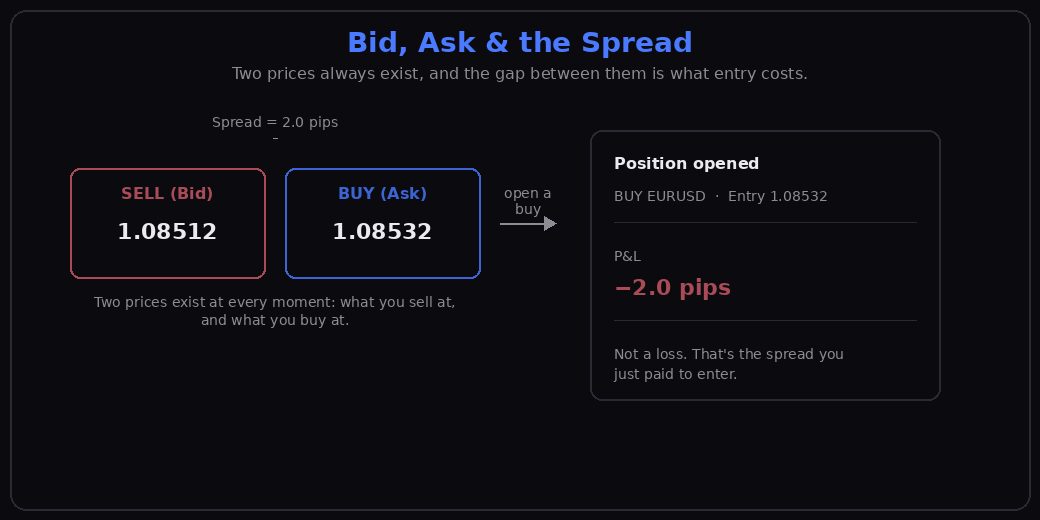
There are always two prices: the Bid (the price at which you can sell) and the Ask (the price at which you can buy). The Ask is always slightly above the Bid. The difference is called the Spread — it's the market's built-in fee.
The Three Order Families
1. Market Order — "immediately, at the current price." You buy or sell now, at the next available price. Quickly executed — but in hectic moments, the execution price can differ from the displayed price. This deviation is called Slippage.
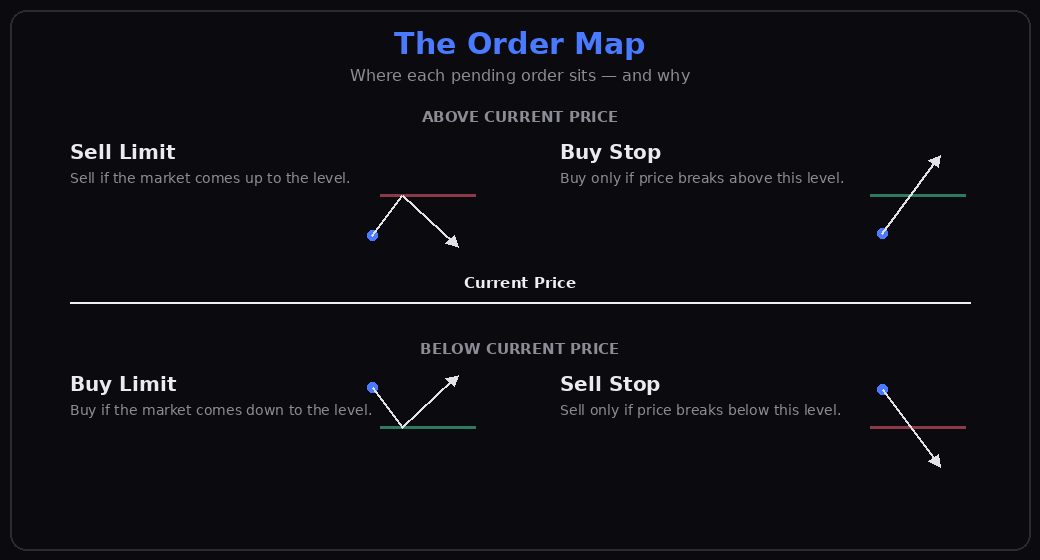
2. Limit Order — "only at my price or better." A Buy Limit is placed below the current price: "Buy if the market comes down to me." A Sell Limit is placed above the price. Limit orders are the tool of the patient trader — allowing the market to come to their zone instead of chasing it. 3. Stop Order — "only if the market proves it." A Buy Stop is placed above the current price: "Buy only if the price breaks this level upwards." A Sell Stop is placed below. Stop orders trade breakouts.
The Two Protective Orders
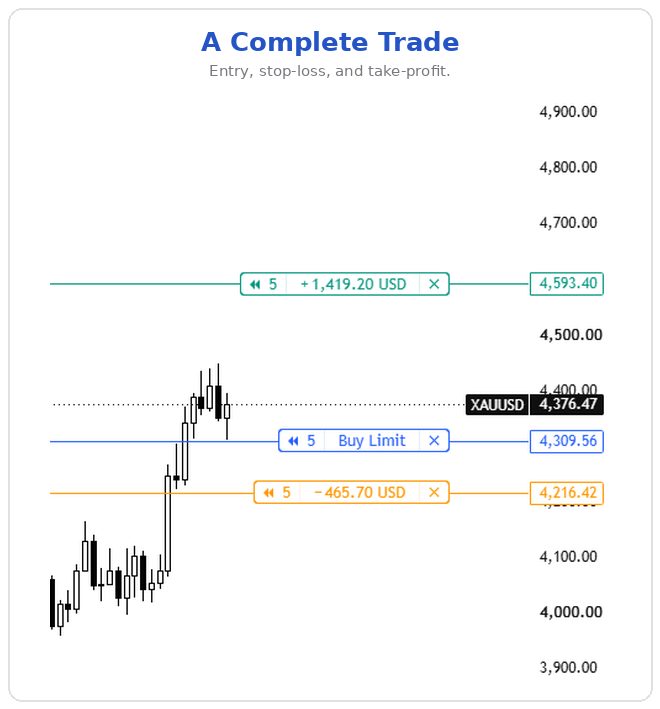
Stop-Loss (SL): an order that automatically closes your position if the loss reaches a predefined level. If you are long (bought), the Stop-Loss is below your entry. If you are short (sold), it's above.
Take-Profit (TP): the counterpart — an order that automatically closes the position when your target is reached. It secures profits, even if you are not at your screen.
Lots and Leverage — Short and Honest
Position sizes in FX are measured in Lots: A standard lot is 100,000 units of the base currency, a mini lot 10,000, a micro lot 1,000. As a rule of thumb: for EURUSD, a pip with a standard lot is worth about 10 dollars — with a micro lot about 10 cents. The position size thus determines what a pip means to you.
| Lot Size | Units | Pip Value (EURUSD, rough |
|---|
| Standard Lot | 100.000 | ≈ 10 $ |
| Mini Lot | 10.000 | ≈ 1 $ |
| Micro Lot | 1.000 | ≈ 0.10 $ |
And then there's Leverage. Brokers only require a fraction of a position's value as collateral — the Margin. This allows you to control positions larger than your account. This is, above all, one thing: a magnifying glass for both — profits and losses.
I understood the order types in an afternoon — truly living by the phrase "no trade without a Stop-Loss" took years. Make the stop a habit before you know your first real position.
Knowledge check
1. You want to buy, but only when the market comes back to a lower zone. Which order?
2. You want to buy, but only when the price breaks an important high upwards. Which order?
3. Why does every trade start slightly in the red?
4. What does leverage do to profits and losses?
5. Where is the Stop-Loss placed for a long position?