Lesson 1.5
Fractality & reversibility
One principle, all levels, both directions
In short: Every wave consists of smaller waves and is itself part of a larger one —
according to the same rules, on every level. And the structure has no preferred
direction: Everything applies in a mirror image in a downtrend.
Principle 1: Fractality — the market is built on self-similarity
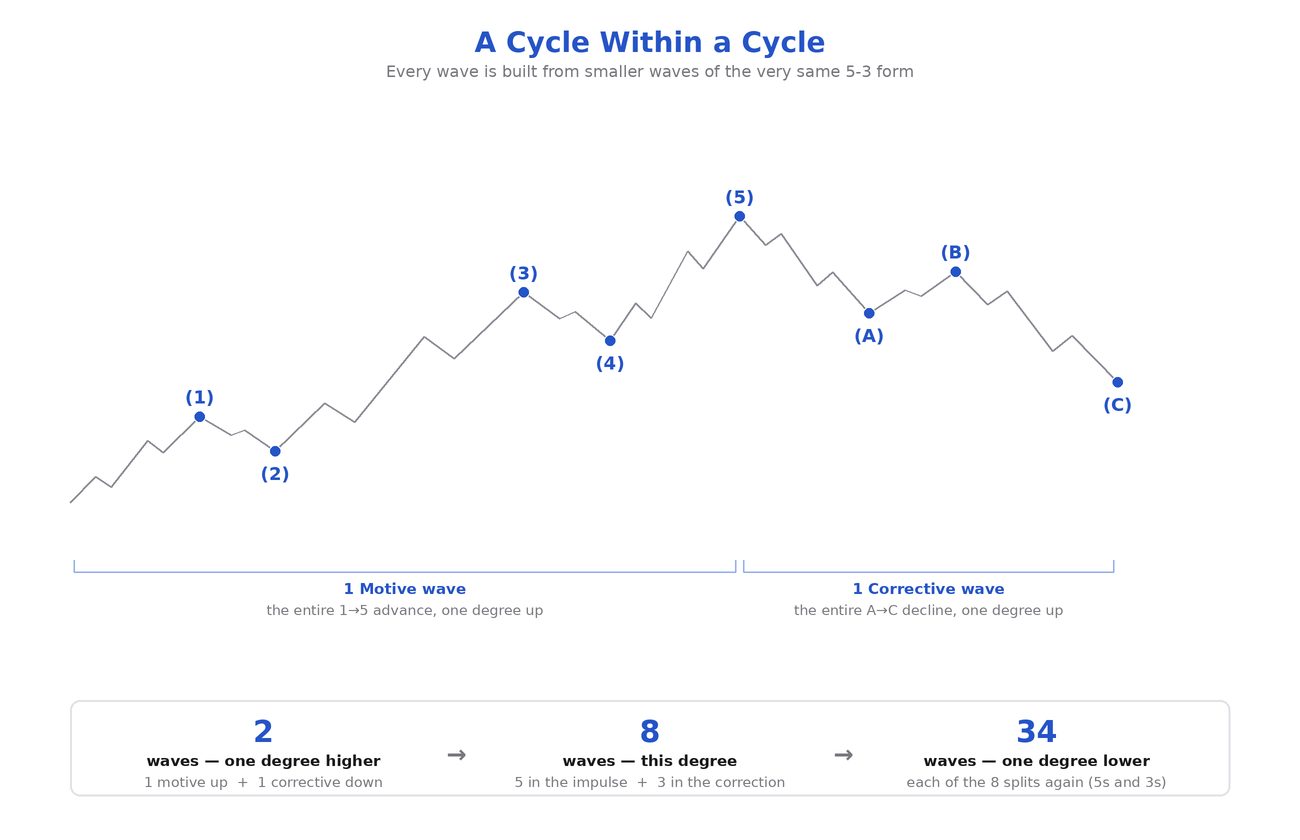
The subdivision follows the allocation rule from 1.2: A wave subdivides into five waves (Motive mode) if it moves in the same direction as the wave one level higher — and into three waves (Corrective mode) if it moves in the opposite direction. Additionally, two rules you will constantly use from Module 2 onwards: The actionary subwaves of an impulse (1, 3, 5) are themselves motive — and the third subwave is always an impulse, never anything else. (Five defined exceptions belong to the corrective patterns and are covered in Modules 3 and 4.)
If you count the waves across the levels, a remarkable sequence emerges: 2 waves, one level lower 8, another level lower 34 — numbers from the Fibonacci sequence. The practical significance — Fibonacci ratios for price targets — will be introduced in Module 2.
What Fractality Delivers in Practice
1. One set of rules for all levels. The three rules from 1.3, the structures from 1.2, and all
2. The substructure as a verification tool. Whether a move is Motive or Corrective is not
Principle 2: Reversibility — the structure has no preferred
direction
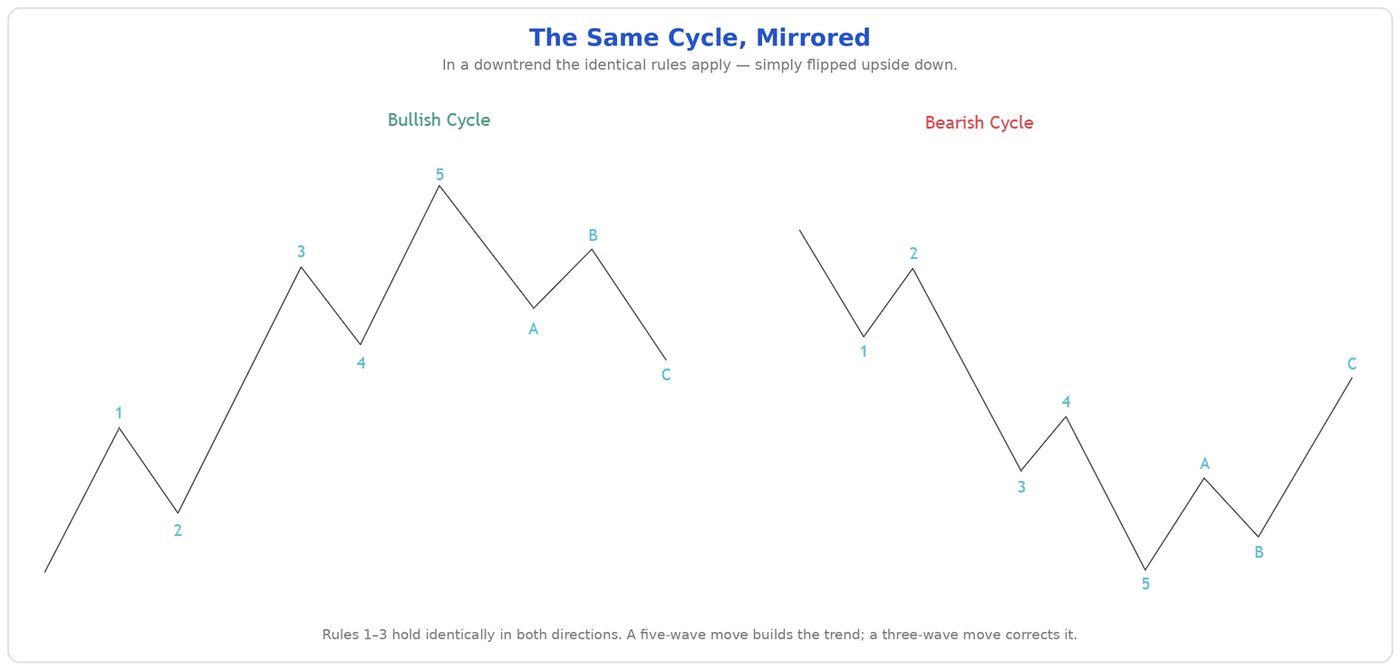
All patterns in this module have been shown in an uptrend. The Wave Principle itself is directionally neutral: all definitions, rules, and guidelines apply in a downtrend in mirror image and without any change in substance. This can be seen in the basic cycle: Within the A-B-C correction of an up-cycle, the downward-pointing waves A and C are composed of five waves — the upward-pointing B of three.
- The five-wave Motive structure (1–5) unfolds downwards; its waves 2 and 4 are upward reactions.
- The three-wave correction (A–B–C) unfolds upwards as a rally.
- The rules are mirrored: Wave 2 cannot retrace beyond the start of wave 1 · Wave 3 is never the shortest actionary wave · Wave 4 cannot move into the price territory of wave 1.
The mental connection "up = impulse, down = correction" is one of the most common sources of error in bear markets — and is ruled out from the start by the terminology of this module.
From here on, it is assumed:
1. Every pattern shown in an uptrend applies in mirror image in a downtrend. 2. Every labeled wave has a substructure according to the allocation rule — even if it is not drawn.
What you can do now — and what comes next
You now have the complete foundation: You know why markets form patterns (1.1), which basic pattern they form (1.2), which three rules hold it together (1.3), how every wave gets a unique address (1.4) — and that a single set of rules is sufficient for all levels and both directions (1.5). After this, Module 2 opens up the five-wave structure from the inside: the anatomy of the impulse wave, its extensions, the diagonal — and the first concrete price targets.
Fractality was the moment for me when 'many timeframes' became a single market. Since then, my levels no longer argue with each other — they control each other.
Knowledge check
1. When does a wave subdivide into five waves?
2. How do you check if an unclear move is Motive or Corrective?
3. Which waves of an A-B-C correction in an up-cycle are composed of five waves?
4. Can an upward move be a Corrective structure?
5. What number sequence results from counting the waves across the levels?